What if China discovered three cushion billiards
By Bert van Manen, February 2014
The 2014 Istanbul World Cup could have had all-Korean semifinals, but Eddy Merckx prevented that. Still, three of the last four players from one country? That is very rare. Three from Korea? That had never happened in history. The seeds that were planted by Sang Chun Lee are bearing fruit. The Koreans are now as good as anybody, they come in numbers and they mean business.
A few years ago, Kyung Roul Kim (the big guy) joked that he was the nr. 4 player in the world, and the nr. 6 player in Korea. At that time, we knew him and Sung Won Choi, but had not yet seen much of Jae Guen Kim, Choong Bok Lee, Jung Han Heo, Dong Koong Kang, Hwang Hyung Bum and Jae Ho Cho. All eight, in case you did not know, are world class players now. And there is plenty more where they came from. Last year, I watched the Suwon qualifications on Kozoom, and saw a Korean player I had never heard of, by the name of Sang Um Pil. I am positive that he had never played in any international tournament in his life. And yet, he made his 30 points in 7 innings...
Danish player Allan Jensen told me he was watching tv-commercials in a hotel room in Seoul, at primetime, and it went: breakfast cereal / cars / cues / mortgages. Could that happen in YOUR country? Not in mine.
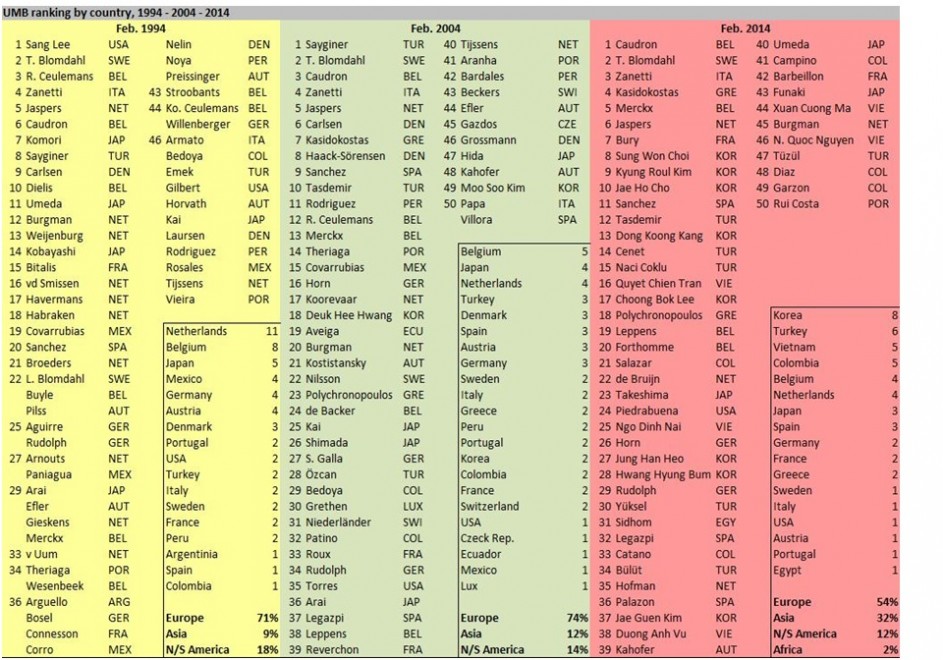
It can’t be denied, a shift is taking place in 3-cushion, and the move is eastward. Nothing much happens in North America. South America’s Colombia is producing new and good players but they are not quite ready yet. The traditional centre of gravity is Europe, but its star players are in their forties and fifties. Asia is where things happen now, not just in Korea but also in Vietnam. Would you have guessed that Vietnam currently has more players in the top 50 than Belgium? China is already snooker-crazy. What if that huge country with all its new wealth and a well-documented love of skill-sports were to discover 3-cushion? They’d be bloody good at it too, I bet.
For this little comparison between 1994, 2004 and 2014, I have looked only at the top 50 of the ranking, and for a good reason. The lower you get down the list, the less relation there is between a player’s actual playing strength and his ranking. In the seventies or nineties on that UMB list, you may find players who have 30 points, which they have won in their national championship. We may never have seen them at any World Cup, and their average could be 1.1, or 0.7. We could also come across recreational players, who can afford to travel to every World Cup and are awarded with 3 or 4 points each time, for their loyalty. Their playing strength could be 0.6 or even less. So the credibility of the UMB ranking is pretty high when it comes to the first 30 or 40 places, rather low from the sixties down.
It’s not just the 30 points for national championships that can place players higher than they should be, it’s also the 80 points for a Confederational win. I have argued several times in the past, that the Pan-American win should not be worth the same 80 points as the Asian or European title, and it is now about to get worse. Africa has its own Confederation, Egypt being the head, body and limbs of that organization (the ACC), other countries from that continent providing a toe and a pinky at most. We are probably going to see Sidhom Sameh cash 30 + 80 points and make spectacular progress on the UMB ranking. He is a fine young man and an excellent player, I wish him well. But it would be absolutely impossible for any European contender with Sidhom’s average to do the same, and I would be surprised if the players who are currently just outside the protected top 12 take this without protest. They shouldn’t, and the UMB should listen to reason. UMB president Mr. Dupont, when asked about this matter, confirmed that the winner of the ACC confederational championship WILL receive 80 world ranking points, 2nd place finisher 54, but ignored my question about the blatant unfairness involved.
Here’s a thought: Where are the Danes? Nelin and Haack-Sörensen are semi-retired, Lohse is listed, but what about Carlsen, Andersen, Zola Hansen, Knudsen? Very capable of playing themselves into the top 50, if they tried. The Germans too, with Frings, Schirmbrand, Eggers, both Galla’s, Lindemann, Bosel and Christodoulidis have plenty of second-echelon players and are underrepresented in the top 100 of the UMB ranking. I would love to see more European 1.0 / 1.3 players travel to World Cups. I know it’s money out-of-pocket, but it’s money well spent.
Table : UMB-Ranking 1994, 2004, 2014